
In plastics manufacturing, cooling is not just a utility. It is part of the production process, and it can determine how quickly you can make a part, how consistently that part meets specification, and how much you spend on energy and scrap.
If mold cooling is too slow or inconsistent, you may be waiting longer between cycles, struggling with warped or blemished parts, or adjusting machine settings to compensate. The right process cooling setup helps you remove heat reliably and gives your operators a more stable process to manage.
Hirate America supplies Thermal Care process cooling equipment for plastics manufacturing. We can help you understand the options and plan a solution that fits your machines, molds, facility, and future production needs.
Why cooling affects cycle time and part quality
During molding, heat must be removed from the plastic so the part can hold its shape when it leaves the mold. In injection molding, the part needs to be sufficiently solid before ejection. In blow molding, the formed container needs to cool enough to retain its shape and meet quality requirements.
If cooling is inadequate or uneven, you may see:
- Longer cycles while operators wait for parts to cool enough to eject.
- Warpage, shrinkage variation, sink marks, or parts sticking in the mold.
- Inconsistent results across cavities or production runs.
- More troubleshooting, rejected parts, and unplanned downtime.
A faster cycle is useful only if the finished part still meets requirements. Pushing coolant temperatures too low without considering the resin, mold design, flow, and process can create other problems. The aim is controlled, uniform heat removal, not simply the coldest water possible.
Cooling demand also depends on the part and process. Wall thickness, resin properties, mold temperature, and cooling-channel design all play a role. Toray’s overview of molding cycle time is a useful reference for understanding how cooling fits into the overall cycle.

Central chillers, portable chillers, and temperature control units
These equipment types all manage heat, but they serve different jobs. Choosing among them starts with understanding what needs to be cooled, how many processes share the load, and how precise the temperature must be.
1. Central chillers: one cooling source for many users
A central chiller produces chilled water for distribution around the plant. It can serve multiple molding machines and other process loads through a piping and pumping system.
Central chillers are often a good fit when:
- Several machines need cooling in a similar temperature range.
- Your cooling demand is substantial or expected to grow.
- You want a coordinated plant-wide system rather than individual chillers beside each machine.
- Your facility can support the piping, pumps, controls, and space the system requires.
The benefit is centralized management of a shared cooling resource. But a central system needs thoughtful design: equipment capacity, flow, pressure, distribution, and the mix of connected loads all matter. A chiller can show the right supply temperature and still fail to deliver the required flow at a mold.
2. Portable chillers: cooling where you need it
Portable chillers are packaged units designed to provide cooling close to a machine or process. They can be useful for a standalone machine, a temporary need, a new production area, or an application with different cooling requirements from the rest of the plant.
They may make sense when you need:
- A flexible, relatively self-contained solution.
- Cooling for a new machine before a central loop is expanded.
- A dedicated source for one process or a specific operating temperature.
- A way to add capacity without redesigning the whole plant system.
Portable does not mean one-size-fits-all. You still need to confirm cooling capacity, pump flow, pressure, operating conditions, and the actual load. Thermal Care’s AccuChiller NQ specifications show how available models differ in capacity and pump performance.

3. Temperature control units: precise mold or process temperature
Temperature control units (TCUs), often called thermolators, manage the temperature of a process circuit, such as a mold. Unlike a chiller, which primarily removes heat to provide chilled fluid, a TCU can heat the circulating fluid as well as cool it. That lets it maintain a target temperature when the application calls for tighter control or an elevated setpoint.
A TCU may be appropriate when:
- Your mold or process requires a controlled temperature rather than simply the coldest available water.
- You need to bring a mold to operating temperature at startup.
- Temperature stability is important to part appearance, dimensions, or repeatability.
- Different molds or processes need different temperature settings.
The choice between water and oil, and the required operating range, depends on the application. Thermal Care’s process cooling equipment page lists central chiller systems, portable chillers, and water and oil mold temperature controllers.
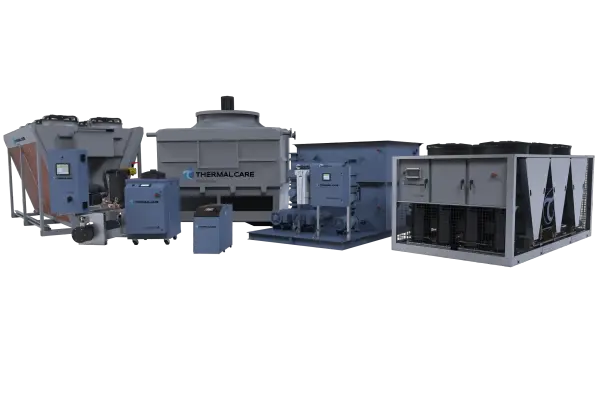
When should you use each option?
A simple starting point is to consider whether you need to make chilled water, deliver cooling to a particular machine, or actively control a mold temperature.
- Consider a central chiller when multiple processes share a compatible cooling requirement and a plant-wide loop is practical.
- Consider portable chillers when cooling is needed for an individual machine, a temporary load, an expansion, or a process with a distinct requirement.
- Consider a TCU or thermolator when the mold needs active heating and cooling or when a tightly controlled mold temperature is central to process consistency.
Some facilities need more than one type. A chiller may supply cooling to a plant loop, while a temperature control unit manages the mold circuit. A new or growing operation might begin with a portable chiller and plan for a central system as production expands. The right answer depends on your loads, layout, operating schedule, and goals, not just the equipment label.
How to get more from the cooling equipment you have
Before assuming you need a bigger chiller, check whether the cooling is reaching the process effectively. A practical review can include:
- Compare supply and return temperatures. The difference can help show how much heat the process is removing, but it should be considered alongside the application’s requirements.
- Check flow and pressure at the machine or mold. Restrictions, dirty filters, air, or undersized pumps can limit performance even when the chiller is operating.
- Look for uneven cooling. Hot spots or unbalanced mold circuits can keep you from safely reducing cooling time.
- Review maintenance and operating conditions. Fouled heat exchangers, blocked strainers, poor airflow, and changing ambient conditions can affect capacity.
- Track production outcomes. Compare cycle time, part quality, scrap, and energy use before and after process adjustments.
This is where a properly selected PLC control, alarms, and clear supply-and-return temperature monitoring can help operators spot changes sooner. The Thermal Care NQ documentation, for example, describes temperature displays, deviation alarms, and options for variable-speed compressor control. Those features can support visibility and part-load efficiency, but the best configuration depends on your specific operating profile.
Build the ROI around your plant’s numbers
The financial case for process cooling is specific to each facility. A shorter cycle can create more available machine time, while stable cooling may reduce scrap and troubleshooting. Energy savings depend on the existing equipment, load profile, operating hours, and system design.
To estimate potential return, compare:
- The current and target cycle time, while confirming part quality is maintained.
- Scrap and rework costs linked to cooling-related variation.
- Current cooling energy use and expected equipment operating costs.
- Installation, piping, maintenance, and production-disruption costs.
A simple payback estimate is project cost ÷ annual net savings. Use your own production and utility data rather than relying on a generic payback period. A cooling review can help identify which savings are realistic before you invest.
A personal partner for your cooling project
Process cooling touches machines, molds, piping, controls, utilities, and production targets. If you are new to manufacturing, or adding capacity to an established plant, it can be difficult to know where the cooling system ends and the process problem begins.
Hirate America can walk you through the options, from individual portable chillers and temperature control units to integrated, turn-key process cooling plans. As one Hirate customer, Larry, put it: “There is incredible peace of mind knowing that you’re in the hands of professionals.”
Explore our cooling and temperature control solutions or get in touch with Hirate America to discuss an upcoming project. We’ll help you evaluate the application and identify a practical path forward, without pressure.